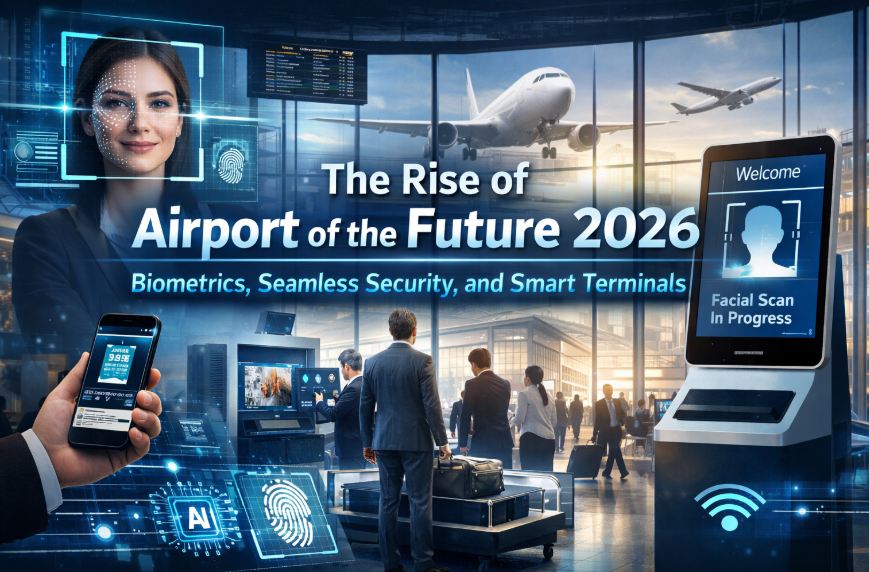
In 2026, the airport of the future is being shaped by biometrics, seamless security, and smart terminal technology that upgrades both passenger experience and airport operations. Across major hubs, digital identity and contactless travel are reducing friction at check-in, bag drop, security, and boarding with measurable gains in on-time performance and aviation efficiency. At the same time, regulators and operators are tightening data privacy, aviation cybersecurity, and compliance to protect biometric security systems and critical airport IT infrastructure. As these trends converge, “smart airports” are becoming a premium platform for high-value airport retail, airline revenue, and advertiser-friendly travel technology growth.
Biometrics and Digital Identity: The New Boarding Pass in 2026
In the airport of the future 2026, biometric technology is replacing paper documents with a secure digital identity that can verify passengers in seconds with face recognition, fingerprint authentication, or iris scanning. This biometrics-driven passenger journey reduces manual checks at self-service kiosks, automated bag drop, and e-gates, which improves airport throughput and strengthens identity assurance at every checkpoint. Because a unified airport biometrics platform can connect airline systems, border control workflows, and airport security processes, travelers see fewer queues and airports see better capacity management outcomes. Importantly, successful deployments in smart terminals depend on high-accuracy matching, strong liveness detection, and resilient edge computing so that biometric verification remains fast even during peak international travel demand.
However, the biggest success factor for biometric security in 2026 is trust, because data privacy and biometric data protection directly affect adoption, compliance, and brand reputation in aviation. A modern digital identity program needs explicit consent flows, transparent data retention policies, and secure encryption that aligns with privacy-by-design and regulatory compliance expectations. For airline partners and airport authorities, aviation cybersecurity controls like zero-trust access, tokenization, and continuous monitoring help prevent identity fraud and protect mission-critical airport systems. When airports combine biometric authentication with clear opt-in choices and strong governance, the “airport of the future” becomes both frictionless and defensible for travel risk management.
Seamless Security: Risk-Based Screening and Faster Passenger Flow
In the airport of the future 2026, seamless security is increasingly powered by risk-based screening and smarter decisioning that focuses resources where they matter most for airport security performance. Instead of treating every traveler the same, security technology uses verified digital identity, travel document checks, and behavioral signals to support a more efficient security checkpoint flow. This approach elevates passenger experience because low-risk travelers move faster through automated lanes, while security teams prioritize secondary checks using better threat detection tools. As a result, airports can improve queue management, reduce missed flights, and create a calmer terminal environment that supports premium airport services.
The key enablers of seamless security in 2026 include advanced imaging, automated tray return systems, AI-assisted detection, and integrated data platforms that improve operational resilience and screening accuracy. Modern smart security models also rely on robust aviation cybersecurity because connected scanners, cameras, and analytics systems expand the digital attack surface of airport infrastructure. Airports that invest in secure network segmentation, device hardening, and real-time incident response protect both security operations and passenger trust in contactless travel. When smart terminals combine risk-based screening with high-integrity cyber controls, the “airport of the future” can deliver faster flow without compromising security compliance.
Smart Terminals: AI, IoT, and Automation for Airport Operations
A true smart terminal in the airport of the future 2026 uses IoT sensors, AI analytics, and airport automation to manage gates, staffing, baggage, and energy consumption with higher precision. With real-time airport operations dashboards, airports can predict congestion, balance passenger loads, and optimize gate changes to protect on-time departures and reduce disruption costs. This intelligent layer improves aviation efficiency because resources like security staffing, cleaning crews, and ground handling can be deployed based on live demand rather than fixed schedules. For travelers, smart airport technology enables more reliable wayfinding, accurate wait-time predictions, and personalized notifications that strengthen the overall passenger experience.
Equally important, smart terminals in 2026 are becoming “self-healing” operational environments through cloud computing, edge processing, and predictive maintenance for critical assets like baggage belts and passenger boarding bridges. Smart baggage tracking using RFID and automated reconciliation improves baggage handling performance while reducing lost luggage claims that erode airline loyalty and airport satisfaction scores. Because these connected systems touch many vendors, aviation cybersecurity and vendor risk management become essential to protect data flows, APIs, and operational control networks. When airports treat automation as a secure, governed ecosystem, smart terminal infrastructure becomes a dependable foundation for scalable growth in global aviation.
Commercial Growth: Premium Passenger Experience, Retail, and High-Value Advertising
The airport of the future 2026 is also a commercial engine, because frictionless movement powered by biometrics creates more time for premium services, luxury retail, and high-margin airport revenue streams. When passengers spend less time in queues due to seamless security and contactless travel, they spend more time in lounges, dining, duty-free, and curated retail zones that attract high-CPC advertisers in travel, fintech, and consumer electronics. Smart terminals can personalize offers through opt-in digital identity programs, enabling relevant promotions for airport parking, premium fast track, baggage services, and travel insurance with stronger conversion potential. As airports modernize, advertisers value the “captured audience” environment where data-driven placements can be measured through footfall analytics and airport customer journey insights.
At the same time, sustainable growth in airport monetization requires responsible data handling, because data privacy and regulatory compliance influence brand trust and long-term advertiser partnerships. Airports that deploy privacy-safe analytics, aggregated measurement, and transparent consent frameworks can deliver targeted performance marketing without undermining public confidence in biometric security. This balance supports premium partnerships in travel technology, mobile payments, loyalty programs, and airline co-branded financial products that often carry higher ad budgets and stronger lifetime value. In 2026, the winning airport strategy is a unified model where smart terminal technology, seamless security, and commercial design work together to lift passenger satisfaction and unlock scalable airport business growth.
Conclusion: Why 2026 Is a Turning Point for Smart Airports
The airport of the future 2026 is no longer a concept presentation, because biometrics, seamless security, and smart terminals are becoming operational standards across major aviation markets. With the right governance, digital identity can reduce friction while strengthening identity assurance, and risk-based screening can accelerate flow while maintaining security outcomes. Meanwhile, AI-driven operations and IoT automation can make airports more reliable, profitable, and resilient under rising travel demand. Airports that pair innovation with data privacy and aviation cybersecurity will lead the next era of safe, premium, and high-performing global travel.
FAQ: Airport of the Future 2026
1) What is an “Airport of the Future” in 2026?
An Airport of the Future 2026 is a smart airport built around biometrics, seamless security, and smart terminal automation to reduce queues, improve airport operations, and strengthen aviation security. It typically combines digital identity, contactless checkpoints, and real-time operational intelligence to make travel faster, safer, and more predictable.
2) How do airport biometrics work for passengers?
Airport biometrics verify a traveler’s identity using face recognition, fingerprint, or iris scans at touchpoints like check-in, bag drop, security gates, and boarding. A secure digital identity match links the passenger to flight authorization so the airport can deliver contactless travel and reduce manual document checks.
3) Are biometrics safe and private at airports?
They can be, but safety depends on data privacy governance and strong aviation cybersecurity practices. The best programs use consent-based enrollment, encryption, limited retention, access controls, and security monitoring to protect biometric data and reduce identity fraud risk.
4) What does “seamless security” mean in 2026 airports?
Seamless security means faster screening using smarter lanes, automation, and sometimes risk-based screening models to improve security checkpoint efficiency. It aims to maintain strong threat detection while reducing bottlenecks through better equipment, integrated workflows, and optimized passenger flow.
5) Will seamless security reduce safety standards?
Not if implemented correctly with validated screening technology and strong operational controls. In high-performing systems, automation can improve consistency while security teams focus on exceptions, supported by auditing, training, and measurable security compliance outcomes.
Read More