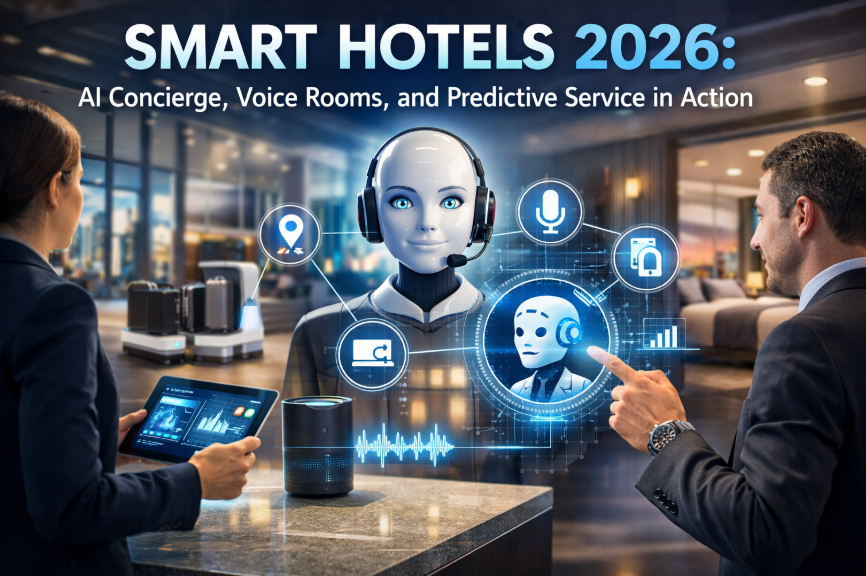
Why “Smart Hotels 2026” Is the New Luxury Standard
Smart hotels 2026 are redefining luxury hospitality by making personalization feel effortless and premium at every touchpoint. In a competitive hotel market, smart hotel technology transforms a standard stay into a high-value guest experience that feels curated, fast, and frictionless. Modern travelers now compare hotels like they compare apps, so digital convenience, instant service, and seamless communication become powerful conversion drivers for hotel bookings. The smartest hotel brands in 2026 use AI concierge services, voice room controls, and predictive service automation to deliver a premium hotel experience that feels both human and high-tech. If traditional hospitality is a handwritten letter, smart hospitality is a perfectly timed conversation that always knows what you need next. That is why smart hotels are becoming a high-ADR category that attracts affluent travelers, corporate travel budgets, and premium advertising demand.
Smart hotels 2026 go beyond installing gadgets, because a smart room alone does not guarantee a smart guest journey. A truly smart hotel experience connects the hotel PMS, guest messaging, IoT room controls, and service operations into a single intelligent service layer. This connected hospitality platform allows a hotel to recognize intent, respond instantly, and reduce service delays that damage online hotel reviews. In 2026, guest expectations are shaped by AI assistants, same-day delivery, and instant digital support, which means hotel response time becomes a brand promise. Smart hospitality also supports hotel profitability, because automated workflows reduce operational waste, optimize staffing, and protect revenue through better service recovery. When smart hotel systems anticipate needs, guests feel cared for, staff feel supported, and owners see measurable gains in occupancy, ADR, and ancillary revenue. In simple terms, smart hotels are not replacing hospitality; smart hotels are scaling hospitality.
AI Concierge in 2026: From Chat Support to Real Trip Designer
AI concierge technology in 2026 feels less like a chatbot and more like a highly trained travel assistant that never gets tired. A modern AI concierge can recommend restaurants, book spa appointments, arrange airport transfers, and answer room policy questions with consistent speed and accuracy. This AI guest service experience matters because travelers want instant hotel communication, especially during arrival, late-night hours, or busy peak seasons. An AI concierge also supports multilingual hospitality, so international guests receive clear, accurate help in their preferred language without waiting for staff availability. In a smart hotel environment, AI concierge tools integrate with hotel systems like the PMS and CRM, enabling guest-specific responses instead of generic replies. That integration creates a personalized hotel experience that improves satisfaction scores and reduces front desk congestion. For hotels targeting premium guests, AI concierge performance becomes a brand differentiator that supports higher room rates and stronger review velocity.
Voice Rooms: How Voice Control Changes the Guest Experience
smart hotels 2026 make the room feel like it is listening for comfort, not just commands. Voice control in hotel rooms allows guests to adjust lighting, temperature, curtains, entertainment, and service requests without touching switches or calling the front desk. This voice-first hospitality experience is especially valuable for travelers who arrive with luggage, feel jet-lagged, or want a seamless stay without friction. Smart hotel voice assistants can also provide real-time information like breakfast hours, spa availability, and local recommendations, which reduces phone calls and improves operational efficiency. In a premium hotel environment, voice room automation supports a luxury feel because it delivers immediate results with minimal effort. A well-designed voice room experience is like having an invisible butler that responds instantly. When implemented correctly, voice technology improves guest satisfaction and helps hotels stand out in competitive markets.
Voice rooms also support accessibility and hygiene, which are two major guest priorities in modern travel. Hands-free room control benefits guests with mobility challenges, elderly travelers, and families managing children, because it reduces physical effort and stress. Voice room systems can also support multiple languages and personalized wake-up routines, which enhances global guest experience consistency. However, smart hotels must balance voice convenience with strong privacy design to maintain trust, especially for high-end travelers. The best smart hotel voice systems use opt-in settings, clear privacy notices, and device controls that allow guests to disable the microphone when desired. This transparency improves guest confidence while still delivering the premium benefits of voice automation. For hotel brands that care about reputation, voice room technology becomes a trust-building feature when privacy is treated as part of luxury.
Predictive Service: Hotels That Anticipate Needs Before You Ask
smart hotels 2026 is the moment hospitality stops reacting and starts anticipating. Predictive hospitality uses analytics, guest profiles, and real-time operational data to forecast needs before a guest experiences friction. For example, predictive service can schedule housekeeping around guest behavior patterns, offer towel refreshes after pool usage, or adjust room temperature based on typical comfort preferences. This predictive guest experience reduces complaints because issues are prevented rather than fixed after damage is done. In a hotel operations context, predictive analytics can identify bottlenecks at breakfast, elevator usage peaks, and staffing demand patterns to reduce wait times. The guest feels like everything “just works,” and that perception is the core of premium hospitality. Predictive service also creates a sense of personalization that supports higher ADR and stronger loyalty.
Predictive service becomes even more valuable when it connects to maintenance and service recovery. Smart hotels use predictive maintenance to detect equipment issues before failure, such as HVAC anomalies, minibar sensor errors, or plumbing pressure changes. This proactive approach prevents room downtime, reduces refunds, and protects hotel review scores that influence booking conversion rates. Predictive service can also detect dissatisfaction signals, such as repeated Wi-Fi complaints or slow response times, and trigger escalation workflows for management. When the hotel fixes a problem before a guest posts a negative review, the hotel protects brand equity and revenue. In that way, predictive service is not just a guest experience strategy; predictive service is a reputation management strategy. In 2026, hotels that master predictive service will outperform competitors who still rely on manual reports and delayed feedback loops.
Smart Check-In, Digital Keys, and Identity Verification
Smart check-in in 2026 is designed to remove the most stressful part of travel: the arrival bottleneck. Digital check-in lets guests confirm details, upload documents where permitted, and receive room readiness updates before they reach the lobby. This hotel mobile check-in experience reduces front desk queues and improves first impressions, which strongly affects guest satisfaction. Digital keys then complete the frictionless arrival by allowing guests to unlock their rooms with a smartphone, smartwatch, or secure access token. For travelers who value efficiency, digital hotel keys feel like VIP access because they eliminate waiting and paperwork. Smart hotels also use identity verification tools to reduce fraud and improve security, which protects both guests and hotel revenue. In premium markets, smooth check-in is not a nice-to-have; smooth check-in is the beginning of the luxury story.
Identity verification in smart hotels must be implemented carefully because trust is a core hospitality asset. The best smart hotel systems use secure data handling, clear consent, and compliance-friendly processes that respect local regulations. Many hotels combine digital onboarding with optional staff support, creating a hybrid hospitality model that serves both tech-forward guests and those who prefer human interaction. This hybrid approach increases adoption while reducing service friction during peak periods. When smart check-in is connected to the hotel PMS, room upgrades and special requests can be confirmed instantly, which increases upsell conversion without pressure. From an advertiser perspective, smart check-in moments are high-intent touchpoints for travel insurance, premium transfers, lounge access, and local experiences. In 2026, the arrival experience is not just operational; it is marketing.
Personalized Room Settings: Comfort Profiles That Follow You
Personalized room settings in smart hotels 2026 turn comfort into a repeatable product. A guest comfort profile can store preferred temperature, lighting brightness, pillow type, wake-up routine, and entertainment preferences. When a returning guest arrives, the smart room automatically applies these settings, creating a “welcome back” effect that feels personal and premium. This personalization strengthens hotel loyalty because it rewards repeat stays with consistent comfort. For travelers, comfort profiles are like bringing your home environment with you, but upgraded for a luxury hotel suite. Smart hotels that deliver predictable comfort reduce guest friction and increase positive reviews. In competitive hotel markets, comfort consistency is a silent advantage that drives repeat bookings.
Personalized room settings also tie closely to wellness travel, which is a high-value hospitality segment in 2026. Smart hotels can offer sleep optimization modes that adjust lighting color temperature, reduce noise triggers, and manage climate stability for deeper rest. Hotels can also provide “work mode” settings with brighter lights and focused temperature control for business travelers. These wellness and productivity features support premium pricing because they deliver a measurable benefit that guests can feel. However, personalization must be privacy-aware, meaning data collection should be transparent and optional. When guests trust the personalization system, they are more likely to share preferences that improve service quality. In the long run, smart comfort profiles create a better product, a stronger brand, and a more profitable guest lifecycle.
Smart Energy and Sustainability Tech That Saves Money
management in 2026 is where sustainability meets profitability in hotel operations. Smart hotels use occupancy sensors, intelligent HVAC controls, and automated lighting systems to reduce energy waste without sacrificing comfort. This energy optimization lowers operating costs, which protects hotel margins during fluctuating demand and rising utility prices. Smart hotel sustainability also supports ESG reporting, which matters for investors, corporate travel buyers, and premium brand partnerships. Many travelers now prefer eco-conscious hotels, especially when sustainability is paired with luxury service. Smart energy systems help hotels market “green luxury” with real metrics instead of vague claims. When sustainability is measurable, it becomes a competitive advantage.
Smart hotels also benefit from predictive energy analytics that adjust systems based on weather, occupancy trends, and room usage patterns. For example, a smart hotel can reduce cooling in unoccupied rooms while maintaining rapid readiness for quick turnarounds. This reduces carbon footprint while maintaining operational flexibility. Smart hotels can also integrate renewable energy sources and energy storage systems into their operational strategy, improving resilience and long-term cost control. From a high-CPC advertising perspective, sustainability tech attracts premium categories like green building solutions, smart HVAC providers, energy management platforms, and ESG consulting. In 2026, sustainability is not a side project; sustainability is a revenue story.
Smart Security and Privacy: Protecting Guests in an AI Hotel
2026 must protect both physical safety and digital privacy because modern guests worry about data as much as door locks. Smart hotels use secure Wi-Fi segmentation, device isolation, and strong authentication to reduce cyber risks that could compromise guest devices. Physical security also improves through smart access logs, hallway sensors, and incident detection workflows that support faster response. For luxury travelers, privacy protection is part of premium service, because discretion is a key value in high-end hospitality. Smart hotels must clearly explain what data is collected, how it is used, and how long it is stored, especially for voice rooms and AI concierge interactions. Transparent privacy policies increase guest trust and reduce reputation risk. In a world of fast social sharing, one privacy scandal can cost a hotel years of brand equity.
A practical privacy-first design includes opt-in voice features, easy device disable options, and secure handling of personal preferences. Smart hotels can also adopt privacy-by-design principles, such as local processing where possible and minimization of unnecessary data retention. Staff training is equally important because security failures often happen through human error rather than technology gaps. When hotels combine strong tech controls with strong internal protocols, they create a secure guest environment that supports premium pricing and corporate travel confidence. In 2026, privacy and security are not blockers to smart hospitality; privacy and security are enablers of smart hospitality. Guests adopt smart features faster when they feel protected.
Revenue Growth: How Smart Hotels Increase ADR and Upsells
Smart hotels 2026 increase revenue by making every guest interaction more relevant and more timely. AI-driven personalization allows hotels to offer upgrades, packages, and experiences that match guest intent, which improves conversion without aggressive sales tactics. For example, a smart hotel can offer a spa package to a wellness-focused guest, or a meeting room discount to a business traveler who asked about printing services. These personalized hotel upsells increase ancillary revenue while improving guest satisfaction because the offer feels like a helpful suggestion. Smart hotels also use dynamic pricing signals, like local demand patterns and booking behavior, to optimize ADR and RevPAR. When data improves decisions, revenue becomes more predictable. For owners and operators, that predictability is a major advantage.
Smart hotel revenue growth also comes from reducing leakage and improving retention. Predictive maintenance reduces room downtime, which preserves inventory and revenue. Faster service recovery prevents negative reviews that reduce conversion rate on OTAs and direct booking channels. Smart loyalty personalization strengthens repeat visits, which reduces marketing costs and improves lifetime value. Even small efficiency gains, like shorter check-in times, can increase guest satisfaction and improve review sentiment that drives future bookings. For high-value advertising categories, smart hotel monetization intersects with premium fintech, luxury travel, corporate travel tools, and hospitality SaaS providers. In 2026, smart hotel technology is not just a cost; smart hotel technology is an investment with compounding returns.
Staff Enablement: AI Tools That Improve Service, Not Replace It
AI staff enablement is one of the most misunderstood parts of smart hotels 2026, because the goal is not to remove people, but to remove chaos. Smart hotel operations platforms provide real-time dashboards that show housekeeping progress, maintenance tickets, guest requests, and service priority levels. This operational clarity reduces miscommunication, improves response time, and helps staff deliver consistent service. AI can also automate repetitive tasks like request routing, translation, and FAQ responses, which frees staff to focus on empathy and complex guest needs. In a luxury hotel, human warmth still matters, but AI makes that warmth easier to deliver because staff are not stuck in manual processes. Think of AI like a backstage crew that makes the main performance look effortless.
Staff enablement also improves scheduling and workload balance, which supports employee satisfaction and service quality. Smart housekeeping optimization can assign rooms based on proximity, urgency, and guest schedules, reducing wasted steps and improving room readiness timing. Predictive maintenance tools can create work orders before failure, reducing emergency calls and stressful incidents. When staff have better tools, they deliver better service, and better service drives better reviews and stronger revenue. In 2026, hotels that treat AI as staff support will outperform hotels that treat AI as a replacement strategy. Guests can feel the difference between a hotel that is efficient and a hotel that is cold.
Real-World Smart Hotel Use Cases Guests Actually Notice
The best smart hotel features are the ones guests notice without needing a tutorial. Guests notice when the room is ready earlier because housekeeping workflows are optimized by AI. when Wi-Fi works reliably because network management is designed for high-density devices. Guests notice when service requests are fulfilled quickly because the AI concierge routes tasks to the right team instantly. These “invisible wins” shape guest perception because they reduce friction and increase comfort. In a 2026 travel environment where review platforms influence bookings, small improvements can create big business impact. Smart hotels win when guest experience becomes smoother, quieter, and more consistent.
Guests also notice smart hotels when service recovery is faster and more personal. If a guest complains about noise, a smart hotel can detect room availability and offer a quick relocation option with digital key transfer. If a guest requests extra pillows, the request can be tracked, confirmed, and delivered with minimal delay. When smart hotel systems reduce uncertainty, guests feel more confident, which increases satisfaction and encourages positive reviews. These real-world use cases also support premium brand storytelling because hotels can market “seamless stays” with proof points rather than buzzwords. In 2026, smart hospitality is not about showing off tech; smart hospitality is about removing stress.
What Tech Stack Powers Smart Hotels in 2026
A smart hotel tech stack in 2026 is built on integration, because disconnected systems create inconsistent experiences. The core often includes a PMS for reservations and operations, a CRS for distribution, a CRM for guest data, and a CDP for unifying guest profiles across channels. On top of that foundation, smart hotels add guest messaging platforms, AI concierge layers, IoT device management, and analytics engines. This integration ensures that guest requests, preferences, and service delivery all connect to a single truth. Without integration, smart features become isolated gimmicks that confuse guests and frustrate staff. With integration, smart features become a cohesive guest journey that feels premium.
The IoT layer powers the physical experience, including smart thermostats, lighting controls, smart TVs, occupancy sensors, and voice assistant devices. APIs and middleware tools are critical because they allow these devices to communicate with hotel software systems securely. AI orchestration then turns data into decisions, such as predicting demand, triggering upsell offers, or optimizing staffing. The best smart hotel tech stacks also include cybersecurity tools, consent management, and privacy controls to protect guest data. In 2026, the winning hotels are the ones that treat tech as an ecosystem, not a shopping list. A strong stack is not about having more tools; a strong stack is about having the right tools connected well.
Implementation Roadmap for Hotel Owners and Operators
Implementing smart hotel technology in 2026 should start with quick wins that deliver measurable ROI. Smart check-in, guest messaging, and digital keys often provide fast operational improvements with high guest satisfaction impact. After that, hotels can expand into voice room controls, comfort profiles, and predictive service workflows. A pilot-first approach reduces risk because it allows teams to measure adoption, identify friction, and refine staff training. In hotel operations, change management is as important as technology selection, because staff workflows determine whether tech becomes helpful or ignored. A smart implementation plan includes clear KPIs like response time, satisfaction scores, energy savings, and upsell conversion. When the business case is measurable, investment decisions become easier.
Vendor selection is also critical because smart hotels depend on reliability, security, and long-term support. Hotel owners should evaluate integration capability, data ownership terms, privacy compliance, and maintenance requirements before committing to a platform. A strong vendor will provide onboarding, training, and reporting that supports continuous improvement. Hotels should also plan for guest education in a subtle way, such as room signage and in-app tips that explain key features without overwhelming the guest. In 2026, the smartest hotels are not the ones with the most technology; they are the ones with the best execution. Execution is what turns a smart hotel project into a profitable smart hospitality brand.
The Future Beyond 2026: What Comes Next
The future beyond 2026 will push smart hotels toward ambient computing, where technology disappears into the environment. Guests will interact less with screens and more with seamless systems that respond to context, preferences, and behavior patterns. Emotion-aware service may also evolve, where hotels detect stress signals through indirect indicators like repeated support requests or delayed responses, then escalate service recovery proactively. This future requires strong ethical standards because personalization must never feel invasive. The best hospitality brands will treat trust like a premium amenity. In a world where AI is everywhere, trust becomes a differentiator.
We will also see smarter partnerships between hotels and local experience providers, powered by AI concierge integrations. Smart hotels can curate experiences based on guest profiles, seasonality, and local demand while ensuring quality control. Hotels may also use advanced digital twins for operations, simulating energy usage, staffing plans, and guest flow to optimize performance before problems happen. This predictive hospitality model will make hotels more resilient, more sustainable, and more profitable. In 2026 and beyond, the hotel becomes a living system that learns, adapts, and improves. The winners will be the brands that balance technology with warmth.
Conclusion
Smart hotels 2026 combine AI concierge services, voice room controls, and predictive service automation to create a guest experience that feels effortless, premium, and consistently personalized. When the tech stack is integrated, privacy-first, and staff-friendly, smart hospitality improves satisfaction while boosting revenue through higher ADR, better upsells, and stronger loyalty. The real magic is not the hardware or the software, but the way smart hotel systems remove friction and deliver comfort at the perfect moment. In 2026, smart hotels are not just a trend; smart hotels are the new standard for luxury travel and high-performance hotel operations.
FAQs
1) What is an AI concierge in smart hotels 2026?
An AI concierge is a digital guest service assistant that provides instant support, recommendations, bookings, and personalized help through chat or voice, often integrated with hotel systems.
2) Are voice rooms safe for privacy in smart hotels?
Voice rooms can be privacy-safe when hotels use opt-in controls, clear consent, secure device settings, and simple options to disable voice features during the stay.
3) What is predictive service in a smart hotel?
Predictive service uses analytics and operational data to anticipate guest needs, prevent service issues, and trigger proactive actions like maintenance fixes or personalized offers.
4) Do smart hotels replace hotel staff with AI?
Smart hotels typically use AI to support staff by automating repetitive tasks, improving coordination, and increasing response speed, while keeping human service central to hospitality.
5) How do smart hotels increase revenue in 2026?
Smart hotels increase revenue through personalized upsells, higher guest satisfaction, better reviews, reduced downtime, lower energy costs, and stronger repeat booking performance.
Read More